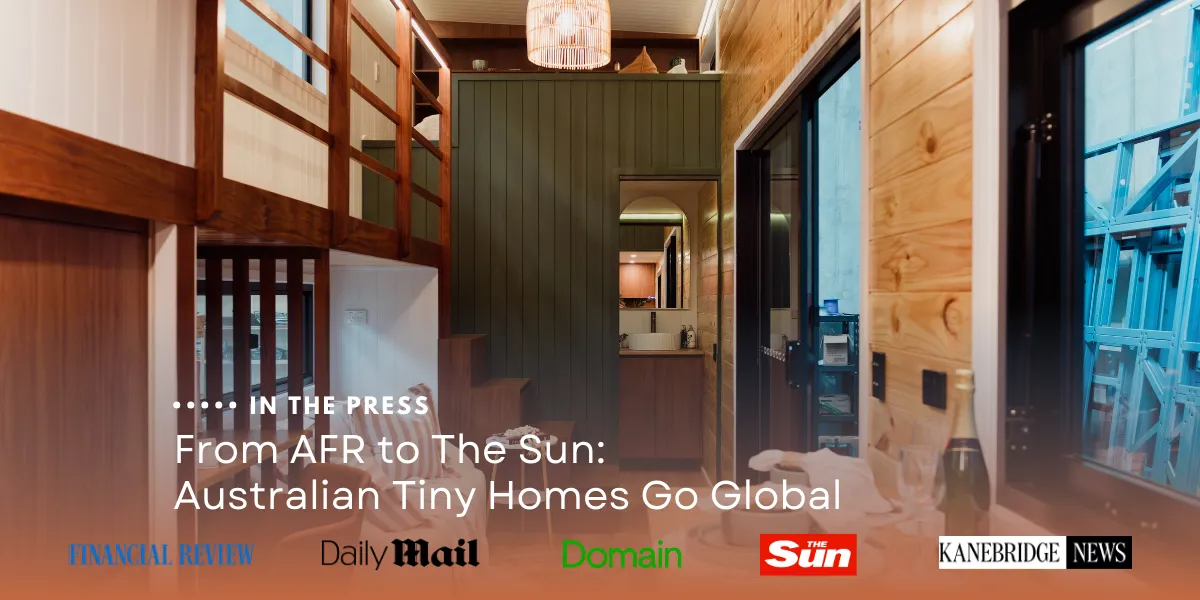
Tiny homes are starting to be talked about differently. Not as quirky lifestyle experiments or Instagram trends, but as practical housing solutions for people navigating affordability, flexibility, and a system that hasn't quite caught up. When mainstream outlets begin framing tiny homes this way, it's a signal that something has shifted.
That shift is exactly why I started Tiny House Agency — Australia's first licensed tiny house buyer's advocate. I saw buyers navigating an unregulated market with no professional representation, sellers unsure how to price or present their homes, and a growing housing crisis where creative solutions were stuck in regulatory limbo. Legitimising tiny homes — in process, pricing, and public perception — became the work.
So when I first connected with Lucy Slade at the Australian Financial Review, the opportunity wasn't just coverage. It was to tell a fuller story: one that went beyond the "look at this small house" angle and explored who tiny homes are actually serving, why demand is growing, and where regulation is falling behind.
One of the case studies was my client Eva, who chose a tiny home in her ex-husband's backyard while co-parenting their children. Unconventional, yes — but driven by motivations that are increasingly common: affordability, proximity to family, and autonomy.
What happened next surprised me. Within weeks, the story was republished across multiple major outlets, reaching audiences well beyond Australia and signalling that this conversation has moved from niche to mainstream.
The Coverage
Australian Financial Review "University of NSW emeritus professor at the School of Built Environment Catherine Bridge says there is no clear definition of what a tiny home which creates a confusing regulatory landscape because individual councils can apply different rules." Read full article →
Daily Mail "Interestingly, no council approval was needed because, technically, the tiny house is classified as a caravan. 'The only rule is you must be a family member to live in it permanently,' Eva explained, cautioning that it's imperative to check local council regulations as the rules differ between councils." Read full article →
Domain "Thanks to the tiny home setup, she is now 'mortgage-free, mostly rent-free, and happily plotting my next chapter'." Read full article →
The Sun (UK) "If it means I live in my ex's backyard, more power to me. I don't have a mortgage. I don't pay rent and I have minimal bills. My husband has his independence, and I have mine – and it works for our family unit." Read full article →
Kanebridge News (Wall Street Journal publication) Print feature - January 2026 View article →
Why This Matters
This coverage matters because it reflects where the housing conversation is heading.
Eva's story resonated not because it's quirky, but because it's practical. Housing affordability has hit a breaking point. The people most affected — often women over 50, single parents, retirees — are looking for alternatives. A $150,000 tiny home isn't a lifestyle choice for most of them. It's a practical solution when a $500,000 apartment is out of reach.
As Professor Bridge told the AFR:
"There are a lot of women, in particular older women, who for a range of reasons do not have much super and if you don't own a home, living on an aged pension once you retire is a disaster because pensions were predicated on the fact that you owned a home and that you'd already paid it off."
The AFR estimates about 10,000 Australians are living in tiny homes — many without clear permission from local councils. Not because they're doing anything wrong, but because the rules simply haven't caught up.
What's Still Broken
Here's the frustrating part: while state governments increasingly acknowledge tiny homes as a legitimate housing option, local councils remain inconsistent.
Professor Bridge put it directly:
"I think there's a huge policy gap, and I think it certainly would be helpful if there was a clearer definition in Australia about what is a tiny house. There's a lot of confusion between tiny houses, manufactured homes and granny flats, and different rules and regulations apply."
Germany and the Netherlands have policies designed to encourage tiny home living. Australia is slower to catch up, but the demand isn't waiting for the regulation.
If You Want to Help
This is where advocacy matters. The Australian Tiny House Association has been advocating for regulatory clarity since 2018. Their petition calls on the Federal Minister for Housing to recognise moveable tiny houses as a legitimate dwelling type — distinct from caravans, and deserving of their own planning pathway.
If you believe people deserve more housing options, not fewer, consider adding your name.
Where to From Here
The conversation is shifting. The question now is whether regulation will keep pace — and whether buyers and sellers will have the support they need in the meantime.
If you're buying, selling, or exploring tiny home ownership — book a free strategy call.