Tiny Home Interior Design
10 Innovative Tiny House Interior Design Ideas To Maximise Space
8 October 2025
19 min read
Tiny Home Interior Design
Living in a tiny house doesn't mean sacrificing style or functionality. With smart interior design choices, you can transform even the smallest space into a comfortable, sophisticated home that feels twice its size.
Across Australia, more people are embracing tiny house living — especially as local councils ease restrictions, land prices rise, and the appeal of downsizing grows stronger. From coastal lifestyle seekers in Byron Bay and the Sunshine Coast to Melbourne investors adding granny flats for rental income, the tiny house movement is reshaping how Australians think about home.
At Tiny House Agency, we help Australians find and purchase their ideal tiny homes — whether you're seeking off-grid builds, urban granny flats, or turnkey tiny houses from trusted builders. Through our [buyers agency service](https://tinyhouseagency.com.au/buyer-agency), we help you navigate builders, regulations, and financing options so you can focus on creating your dream space.
This guide covers 10 proven tiny house design strategies that maximise every square metre while maintaining the quality and comfort you deserve. Whether you're browsing our [tiny house marketplace](https://tinyhouseagency.com.au/marketplace) or planning a custom build, these ideas will help you make informed design decisions.
Let's explore how to make your tiny house work brilliantly for your lifestyle.
### **1. Multi-Functional Furniture Transforms Limited Space**
Multi-functional furniture is the cornerstone of successful tiny house interior design, allowing single pieces to serve multiple purposes throughout the day. A sofa becomes a bed, a coffee table rises to dining height, and a wall panel folds down to reveal a workspace.
Key furniture solutions for Australian tiny homes include Murphy beds from The Comfort Shop in Sydney's Crows Nest, offering Italian-made wall beds starting from $690 with mechanisms that support 250-300kg and accommodate mattresses up to 30cm thick. Space Saving Furniture Australia's hydraulic lifting coffee tables adjust from coffee height to dining or desk level with no assembly required. The AMICO table transforms from a compact console to a 12-seater, with leaves that store neatly through table slats.
Storage ottomans serve as footrests, extra seating, and blanket storage simultaneously, while platform beds with gas-lift mechanisms reveal substantial storage underneath. Delivery typically reaches major cities within 4 days, making these solutions accessible whether you're based in Brisbane, Melbourne, or regional areas.
According to Better Homes and Gardens Australia, every piece should serve at least 2-3 purposes in a well-designed tiny home — form and flexibility are key.
### **2. Loft Bedrooms With Strategic Skylight Placement**
Loft bedrooms free up valuable ground-floor space while creating psychologically cosy sleeping zones. Australian tiny houses typically feature lofts ranging 5-8m in length and 2.4m wide, with 1.2-1.8m ceiling clearance—enough to sit upright comfortably.
The key to preventing a cramped feeling lies in skylight selection and placement. VELUX dominates the Australian market with products tested for local conditions, including hail and extreme weather standards. Their solar-powered opening skylights (VCS series) eliminate electrical wiring requirements, making them ideal for off-grid tiny houses — a popular choice for tree-changers and coastal buyers.
Without proper ventilation, loft temperatures can reach 5-10°C warmer than ground floor according to Uber Tiny Homes research. Openable skylights exhaust hot air — essential for Queensland's subtropical climate. Solar-powered blinds control heat gain during summer, while strategic positioning captures prevailing coastal breezes.
Staircase storage represents the most popular solution for accessing lofts. Quality designs support 250-800 lbs and feature steps 40cm wide for safe climbing. Each step contains deep drawers or cubbies, providing approximately 4-5 cubic feet of storage per step. Australian builders like Aussie Tiny Houses and Evergreen Homes specialise in custom storage stairs that maximise every centimetre.
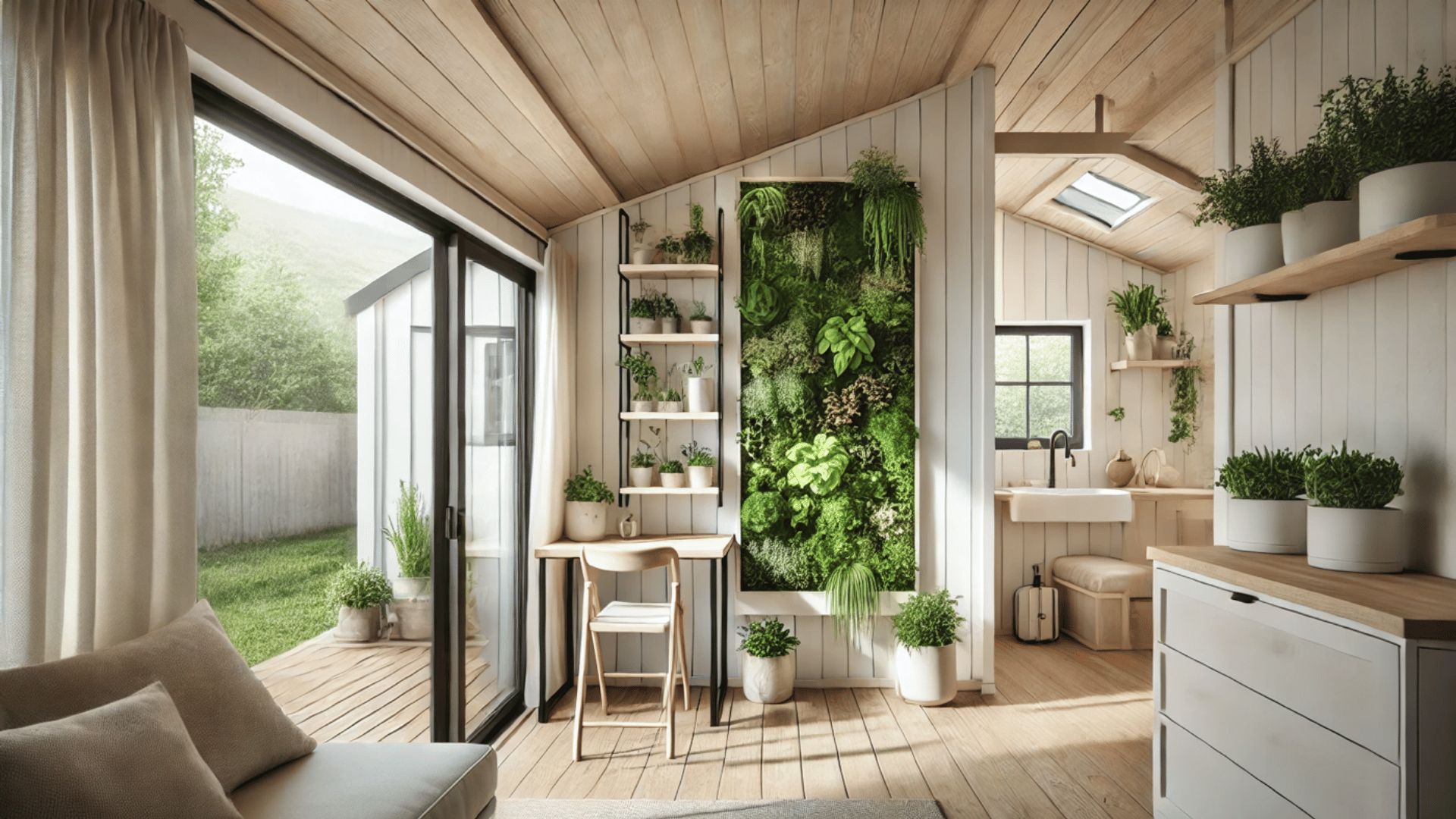
### **3. Vertical Gardens Bring Nature Indoors**
Vertical gardens provide fresh herbs, vegetables, and air-purifying plants without sacrificing precious floor space — perfect for tiny home interiors in Australia's diverse climate zones. Wallgarden's Australian-made system costs under $100 per square metre, featuring BPA-free recycled plastic with 10-year warranties and UV resistance engineered for harsh Australian sun exposure.
Holman GreenWall Vertical Planting Kit, available at Bunnings, offers fully integrated watering systems with pressure-compensating drippers and 8 convenient pots. Installation takes approximately 30 minutes with a hang-and-grow approach, while removable pots allow seasonal plant changes.
Australian native plants work particularly well for tiny house gardens. Bird's Nest Fern tolerates low light with glossy bright green leaves, while Kangaroo Fern thrives in bright spots with consistent moisture. Coastal Rosemary and Karkalla (Pigface) provide edible, pet-safe, drought-tolerant options ideal for water-conscious living.
Position sun-loving herbs like rosemary, sage, thyme, and chives in upper positions, while shade-tolerant plants like mint, philodendron, and ferns work best in lower positions. UV resistance matters critically for outdoor systems—choose products specifically designed to withstand Australian sun levels that can destroy lesser products within months.
### **4. Space-Saving Doors Eliminate Wasted Swing Space**
Traditional swinging doors waste 1-2 square metres per door—space you can't afford in a tiny house. Barn Door Outlet in Melbourne ships Australia-wide with pre-finished doors at $450-$499 for standard 2135x820mm sizes, backed by 3-year door warranties and 10-year hardware warranties.
Barn doors slide along exterior-mounted tracks, requiring no wall cavity modifications. Standard doors need 150-200mm clearance above doorways and full door width in clear wall space beside the opening. Popular finishes include black powder-coated hardware, which remains the most popular choice, with door styles ranging from minimalist slabs to traditional X-brace designs.
Installation proves DIY-friendly, typically requiring 1-2 days and basic tools. Professional installation costs $300-$500 in metro areas if preferred. Bunnings stocks Hume Frontier Barn Doors at $360 and complete track fitting sets at $232, making this an accessible upgrade for any Australian tiny home.
Barn doors work best for closets and wardrobes, pantries and laundry rooms, home offices, and dividing open-plan living spaces. They excel for non-private areas but have limitations — the gap between door and wall allows light and sound passage, making them unsuitable for bedrooms requiring privacy. For ultimate space-saving, pocket doors disappear completely into wall cavities, though they require construction planning. Bifold doors provide a middle-ground solution.
### **5. Layered Lighting Maximises Natural Light and Energy Efficiency**
LED technology reduces energy consumption by 75-80% compared to incandescent bulbs while lasting 25,000-50,000 hours, making them essential for tiny house storage ideas and overall functionality where every watt matters. LED payback periods typically fall under 1 year, with Australian households spending 5-10% of electricity budgets on lighting.
Natural light maximisation begins with strategic window placement and skylights. VELUX's solar-powered skylights provide 3x more natural light than equivalent-sized vertical windows while creating perception of additional space — a game-changer for compact homes.
Layered lighting strategies combine ambient lighting from LED downlights for general illumination, task lighting through under-cabinet LEDs that focus light for cooking, reading, or working, and accent lighting using LED strip lights that add depth and visual interest to tight spaces.
Eco Smart Lighting specialises in LED systems for off-grid applications with minimum 3-year warranties. Their ECO1 Smart Automation system offers smartphone control, earning nomination for 2019 National Awards. Edison Light Globes (ELG) focuses on low voltage lighting for off-grid tiny houses, stocking low voltage LED filament bulbs and E27 fittings adaptable to off-grid systems.
Smart lighting systems maximise efficiency through motion sensors for automatic on/off in bathrooms and hallways. Programmable timers schedule lighting to reduce waste. However, check standby power usage—seek models with 0.5W or less standby consumption to avoid phantom loads undermining efficiency gains in solar-powered systems.
### **6. Open-Plan Layouts Create Visual Spaciousness**
Open-plan layouts fundamentally change how tiny houses feel by removing walls that fragment space. Clear sightlines from one end to the other create perception of significantly greater square footage than actual measurements, with ceiling continuity flowing throughout enhancing spaciousness.
The kitchen-living integration meets contemporary Australian expectations for cooking while entertaining or supervising children — particularly appealing to downsizers who want the lifestyle benefits of tiny living without feeling cramped. Every centimetre serves multiple purposes without wasted corridor space, and natural light from windows or skylights spreads throughout the entire space.
Aussie Tiny Houses' Coogee 10 model provides ground-level bedroom with built-in robes, loft bedroom above living area, and open-plan kitchen/dining/living of approximately 15-18 square metres. Tiny Tect's Wildscape 8.4m offers king/queen loft bedroom or ground-level double bedroom option with open-plan living/kitchen below.
Organisation without walls requires strategic design. Material zoning employs different materials to define functional areas—tile for kitchen, timber for living. Furniture placement creates "rooms" within open space, with breakfast bars or kitchen islands providing natural boundaries between zones.
Privacy challenges resolve through ground-floor bedroom options with sliding doors, loft bedrooms providing separation, or curtain tracks creating temporary zones. For cooking odours, range hoods vented to exterior remain essential, along with cross-ventilation through windows and exhaust fans in kitchen areas. Consider acoustic panels for investor properties intended as rentals to manage noise.
### **7. Built-In Storage Solutions Hide Belongings**
Built-in storage represents the difference between cluttered chaos and serene minimalism — critical for space-saving furniture for small homes. Under-stair storage provides the most popular solution, with each step containing full drawers, varying-sized cubbies, or custom closets built into staircase sides.
Wall-mounted storage maximises vertical space through floating shelves and floor-to-ceiling units, adjustable pegboards for changing needs, and specialised solutions for each room. In kitchens, drop-down ceiling cabinets store spices, pull-out pantries on castors provide accessible storage, and magnetic strips on fridge sides hold knives and tools. In bathrooms, over-toilet shelving units, recessed medicine cabinets, and slim rolling carts between fixtures maximise every centimetre.
Hidden and concealed storage creates substantial storage without visual clutter. Underfloor storage through hinged floorboards placed under desks or couches provides several cubic feet of hidden space for seasonal items or valuables. Built-in furniture storage includes sofas with storage inside cushions, benches with lift-tops, coffee tables with hidden compartments, and beds with drawers or gas-lift bases.
ShelfGenie offers professional design consultation with 3D rendering and custom-designed cabinets for tiny homes. Pull-out shelves and under-furniture storage install typically in one day, backed by Neighborly Done Right Promise and suitable for loft-style tiny homes.
Better Homes and Gardens Australia emphasises multi-functional furniture with built-in storage—sofa beds with undercarriage drawers, extendable tables hiding leaves, and wall shelving doubling as display art. The combination creates homes where everything has a designated place despite minimal square footage — essential for maintaining resale value for investors.
### **8. Strategic Colour Schemes Expand Perceived Space**
Dulux's Natural White (Hex #EEEBE3, LRV 83.08) ranks as Australia's most popular and most neutral white, featuring subtle warm undertones that work with both cool and warm colour schemes while reflecting light beautifully. Taubmans' Cotton Ball (LRV 89.82) provides even higher light reflectance for spaces requiring maximum brightness.
Light Reflectance Values (LRV) above 50 bounce back more light than they absorb, with higher values creating brighter, larger-feeling rooms essential for limited natural light. Semi-gloss or high-gloss sheens add more reflectivity than matte finishes, with glossy paint on doors and trim reflecting light throughout rooms.
Cool blues and greens visually recede, creating depth — perfect for coastal-themed tiny houses in beach communities. Monochromatic schemes using the same colour throughout create seamless flow without visual fragmentation. Light neutrals including bone and earthy tones are trending over stark whites in Australian interior design.
Mirrors represent the primary space-expanding tool, with placement opposite windows reflecting natural light and outdoor views to double visual depth. Large mirrors create more dramatic effects than multiple small mirrors, acting as "window-like" elements. Floor-to-ceiling mirrors maximise illusion of height, making ceilings appear taller and rooms feel longer.
Glossy finishes and reflective surfaces amplify lighting effects. Semi-gloss or high-gloss paint adds reflective qualities that brighten spaces. Glass furniture and acrylic chairs create openness without solid visual weight that makes spaces feel cramped.
Diagonal floor tiles trick the eye into perceiving more expansive spaces compared to standard grid layouts. Continuous flooring throughout without breaks between rooms creates cohesive looks that expand perceived space—an effective technique whether you're styling a granny flat for tenants or a personal retreat.
### **9. Smart Technology Streamlines Tiny House Living**
Smart home technology and space-saving appliances complete the tiny house package by automating functions and providing full functionality in compact footprints. Fisher & Payel Australia specialises in space-saving options including unique DishDrawer dishwashers with drawer-style access, eliminating door swing space.
Space-saving appliances for Australian tiny houses include combination washer-dryers that eliminate separate units, compact dishwashers that fit into minimal cabinetry, and slim refrigerators that maximise food storage in narrow footprints. Portable induction cooktops provide flexibility without permanent installation, while convection microwave ovens combine multiple cooking methods.
Smart thermostats optimise heating and cooling for tiny spaces—particularly valuable in Australia's varied climate zones. Lighting controls through smartphone apps eliminate physical switches. Security systems adapted to tiny houses monitor entry points without bulky equipment.
When integrating smart technology, ensure products operate on compatible platforms (Google Home, Apple HomeKit, Amazon Alexa). Check power requirements against solar system capacity in off-grid installations, and prioritise products with Australian standards compliance and local warranty support.
Energy efficiency ratings matter critically for off-grid or solar-powered tiny houses where every watt counts. Australian energy star ratings guide appliance selection, with higher ratings reducing power consumption and battery drain—essential for remote locations popular with tree-changers and off-grid enthusiasts.
### **10. Australian Climate-Specific Design For All Seasons**
Tiny house design in Australia must accommodate diverse climate zones—from tropical Queensland to temperate Tasmania. For warmer regions, cross-ventilation and shading are essential to keep interiors cool. For colder climates, insulation and double-glazed windows help retain heat.
Climate-responsive design essentials include fire-resistant cladding for bushfire-prone areas like the Blue Mountains, Adelaide Hills, and regional Victoria. Solar panels suit off-grid living in remote locations, while cyclone-rated construction matters for Far North Queensland. Moisture management systems are critical for humid coastal regions including Northern NSW and the Sunshine Coast.
Real Living Australia recommends incorporating materials and systems suited to your specific region, ensuring year-round comfort regardless of location. [Read about climate-responsive design ideas on Real Living](https://www.homestolove.com.au/diy-and-craft/15-tips-to-reduce-your-ecological-footprint-at-home-3369/).
### **Final Thoughts: Designing Smarter, Living Bigger**
A well-designed interior can make any tiny house feel spacious, functional, and uniquely yours. By incorporating clever storage solutions, strategic lighting, and thoughtful space-saving furniture for small homes, you can create a home that fits both your lifestyle and Australia's unique environment.
Whether you're a downsizer seeking a simpler coastal lifestyle, an investor exploring granny flat opportunities for rental income, or anyone in between, these tiny home interiors Australia design principles help maximise every square metre while maintaining quality and comfort.
At Tiny House Agency, we help Australians navigate the tiny house buying journey — from selecting the right builder and design to understanding council regulations and financing options. Our expertise means you avoid costly mistakes and find a tiny house that truly meets your needs.
Ready to find your perfect tiny home? Our [buyers agency service](https://tinyhouseagency.com.au/buyer-agency) provides expert guidance through builders, regulations, and financing options. We'll help you make informed decisions about design, location, and functionality so every square metre works smarter.
[Start your tiny house journey today](https://tinyhouseagency.com.au/buyer-agency) or [explore available tiny homes in our marketplace](https://tinyhouseagency.com.au/marketplace).
Ready to Start Your Tiny House Journey?
Get expert guidance from Australia's trusted tiny house consultancy. Book your free 15-minute consultation to clarify your vision, budget, and next steps.