Sustainable Living
Why Tiny Houses Are Australia's Answer to the Housing Crisis
18 October 2025
20 min read
Sustainable Livinghousing solution
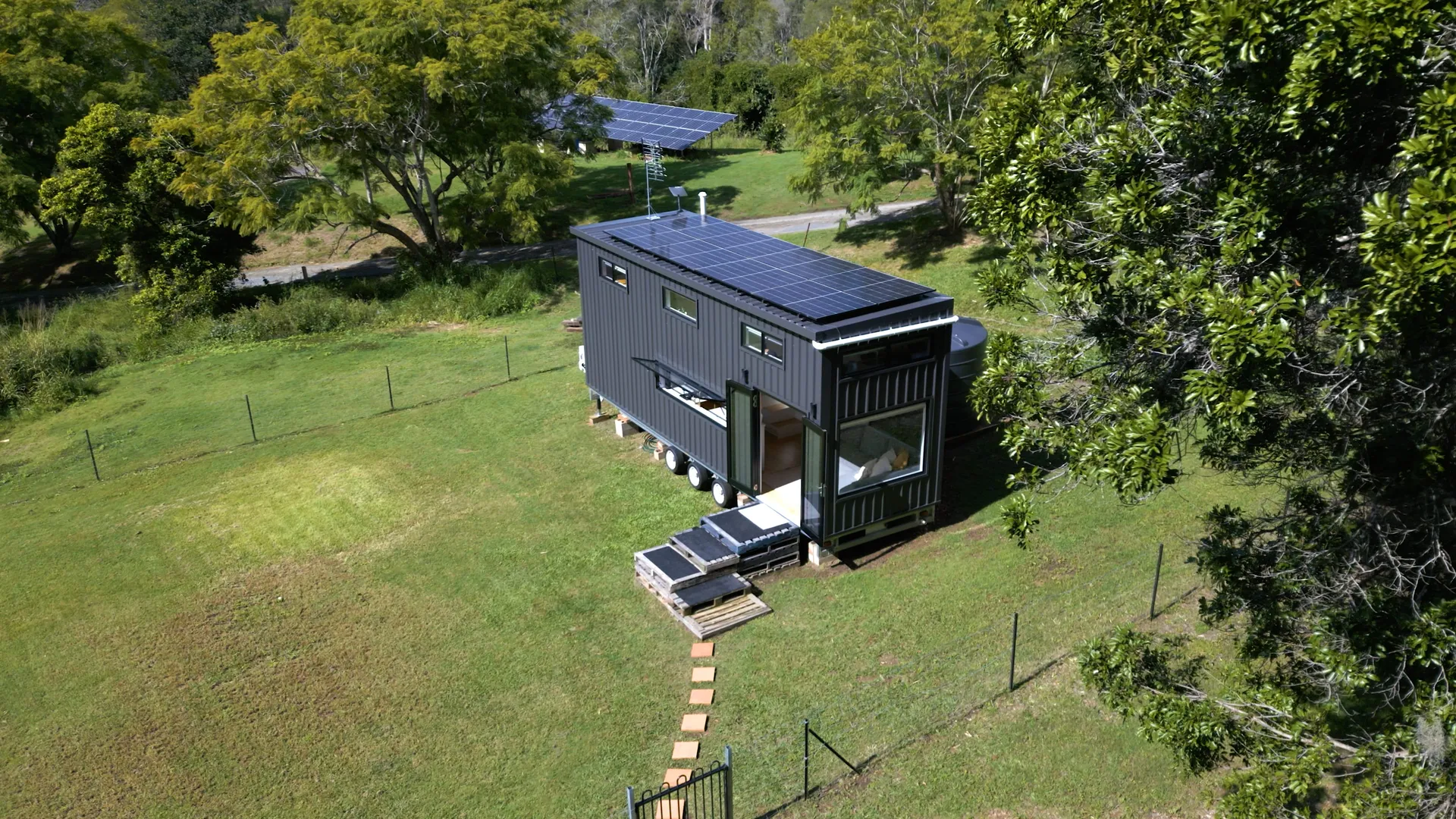
Australia doesn't just have a housing affordability issue — it has a housing supply crisis. The [Australian Housing and Urban Research Institute](https://www.ahuri.edu.au/) estimates we need 1.5 million additional homes by 2050 just to meet population growth and housing demand. Traditional construction can't scale fast enough. Apartments and townhouses help, but the only housing type growing fast enough to genuinely move the needle? Micro dwellings—specifically, professionally designed tiny homes.
At Tiny House Agency, we've watched this shift from fringe to mainstream over the past three years. It's not about minimalist lifestyles or downsizing retirees anymore. It's about families priced out of traditional markets, young professionals with realistic deposit timelines, property owners adding secondary income, and investors chasing genuinely better returns. The average Australian home costs $750,000 with average household income at $90,000. The maths doesn't work on the old model—and that's why a quiet housing revolution is happening in backyards and rural properties across the country.
Here's what you need to know about why small-scale housing works, how much it actually costs, and whether a compact home might solve your specific situation.
---
### **1. The Mathematics of Affordability: Why Traditional Housing Doesn't Work Anymore**
Let's start with brutal honesty. According to the [Australian Bureau of Statistics](https://www.abs.gov.au/), the median house price in Australia is now $750,000. In Sydney and Melbourne, you're looking at $1.1 million-plus. Meanwhile, the ratio of house prices to annual household income has blown out to 9:1 in most capital cities—compared to the historical average of 3-4:1.
That means a first-time buyer in Perth needs to save for 15+ years for a 20% deposit on a median property. In Melbourne, it's closer to 20 years.
Micro dwellings rewrite this equation entirely. A quality Australian-built compact home typically costs between $120,000 and $200,000 for a fully finished, move-in-ready unit. On private land you already own or lease, that's achievable. Even with the land component, you're looking at a total property cost often under $500,000 in most Australian markets—half the price of a traditional home in the same region.
For investors, the numbers are even more compelling: a $160,000 compact dwelling generating $400–500 per week in rental income creates an 11–13% gross yield—compare that to 3–4% on traditional rental properties. The financial model changes the housing conversation entirely.
---
### **2. Location Flexibility That Modern Life Actually Needs**
The old model of buying a house and staying put for 30 years? That's not 2025 anymore.
Australians change jobs an average of 12 times in their working lives. Mining workers, construction crews, agricultural workers, and hospitality staff often work on temporary contracts moving between sites. Remote workers now live anywhere an internet connection reaches. Families with ageing parents need to relocate for caring responsibilities. The reasons to need housing flexibility are endless—and traditional brick-and-mortar homes don't provide it.
Mobile micro dwellings offer something revolutionary: the ability to own your home whilst still being able to move it.
That means the family relocating for a 3-year project can take their home with them instead of starting from scratch in a rental market. The couple who inherits their parent's rural property can live there without committing to a traditional home build. The property owner can move accommodation between different sites without losing their investment.
Even fixed compact homes provide financial flexibility. They cost less to build, so you can establish your own property faster than financing a traditional structure. Many Australian councils now permit additional housing on properties—meaning a secondary dwelling on a quarter-acre suburban block creates optionality that traditional single-dwelling zoning never allowed.
---
### **3. Design That's Deliberately Clever, Not Accidentally Cramped**
Here's where small-space prejudice breaks down fast: a professionally designed compact home isn't a scaled-down traditional house. It's a completely different approach to spatial architecture.
Quality Australian dwellings in this category maximise vertical space (high ceilings, smart lofts), eliminate wasted hallways, use multifunctional furniture, and incorporate storage that works instead of storage that collects. The difference between a 45-square-metre home that feels spacious and one that feels cramped comes down to professional interior architecture—and it matters enormously.
The best Australian builders apply principles that high-end apartment designers use to maximise $2 million Sydney penthouses. They're creating spaces where every square metre earns its place.
Natural light, thermal efficiency, clever ventilation, quality finishes—these aren't luxuries in compact homes, they're necessities. You learn quickly that cheap design fails in a small footprint, which is why well-designed micro dwellings often feel more thoughtfully conceived than traditional homes at 3x the price.
For families specifically, design quality matters: kids' sleeping lofts with actual headroom, bathrooms that don't feel claustrophobic, kitchens designed for real cooking (not just tea-making). When you tour a professionally designed compact home, the first reaction is usually surprise: "It's so much bigger than I expected."
---
### **4. Genuine Sustainability Without Compromise**
Beyond thoughtful design, there's another compelling reason small-scale housing is moving from fringe to mainstream: environmental impact actually matters for modern buyers.
Australia's building sector accounts for nearly 25% of our total emissions, according to the [Australian Government Department of Climate Change, Energy, Environment and Water](https://www.dcceew.gov.au/). Buildings also consume roughly 23% of total energy use and 18% of water—whilst housing demand keeps climbing.
Here's the sustainability maths on compact dwellings: they use 80% less energy to heat and cool than traditional homes, require 60% less water, and generate 50% less waste during construction. Add solar panels (now a standard option, not a luxury), and most homes offset their carbon footprint within 5–7 years.
For Australian families genuinely concerned about climate impact, this matters. You're not choosing a compact home to *feel* sustainable—you're choosing one that *is* functionally sustainable. The difference between intention and actual environmental benefit is substantial.
Many Australian councils also offer rate rebates or planning incentives for properties with secondary dwellings or small-scale housing that meets energy efficiency standards. [Victoria](https://www.planning.vic.gov.au/), [Queensland](https://planning.statedevelopment.qld.gov.au/), and [NSW](https://www.planning.nsw.gov.au/) have all introduced planning reforms to encourage secondary dwellings specifically because of their sustainability profile and housing efficiency.
---
### **5. The Investment Case: Why Property Investors Are Quietly Adopting Micro Dwellings**
Beyond sustainability, there's another reason small-scale housing is moving from fringe to financial mainstream: the numbers simply stack up better.
Real estate investors have quietly figured out what media coverage hasn't caught up to: compact dwellings generate genuinely better returns than traditional rental properties in most Australian markets.
The financial model works like this:
**Traditional rental property in Brisbane:**
$550,000 purchase price → $22,000 annual rent = 4% gross yield
**Compact dwelling in Brisbane:**
$160,000 purchase price → $8,800 annual rent = 5.5% gross yield
**Scale it across 5 properties:**
One traditional house: $550k invested, $22k annual income
Five compact dwellings: $800k invested, $44k annual income across 5 separate assets
Better returns. Better risk management. More flexibility.
Depreciation benefits work better too. Because these dwellings cost less, depreciation deductions represent a higher percentage of your investment basis. The 10-year depreciation schedule available for new builds creates legitimate tax planning opportunities that traditional property investors don't access.
Tenant demand is also shifting. Remote workers want flexibility. Young professionals want affordability. Families want a path to ownership. Compact dwelling rentals attract motivated tenants willing to pay premium weekly rates for properties that offer something the rental market traditionally doesn't: thoughtful design and genuine livability.
The risk profile is lower than traditional property too—if something goes seriously wrong, a $160,000 asset is more manageable than a $600,000 house. You can actually sell or relocate a mobile dwelling in months, whereas traditional properties can take a year+ to shift in slower markets.
Property investors focused on yield over capital appreciation are discovering that compact dwellings—especially in regional Australian markets—deliver better mathematics than what they've been doing.
---
### **6. Important Considerations Before Committing**
Compact home living requires intention and conscious design choices. We'd be overselling if we didn't acknowledge what's genuinely different about this lifestyle.
Small-space living means you can't accumulate endlessly like you can in a traditional home. You need to be comfortable with neighbours being closer (especially in multi-unit communities). You need to adapt your lifestyle to a smaller footprint—though most people who've lived in compact homes report they actually *prefer* the smaller footprint after adjusting.
Some Australian councils remain cautious about secondary dwellings or mobile units, so you need to understand local regulations before purchasing. [Mount Alexander Shire in Victoria](https://www.mrsc.vic.gov.au/) allows mobile dwellings beautifully; [Byron Shire NSW](https://www.byron.nsw.gov.au/Home) has progressive policies; but other councils are still working through their approach. Location absolutely matters—more so than traditional property.
Financing can require different strategies. Banks treat compact dwellings as non-standard security, so getting a home loan can require non-bank lenders or asset finance rather than traditional mortgages. This typically adds 1–2% to interest rates, though rates are normalising as these dwellings become more common in loan portfolios.
Resale is faster than traditional homes (genuine demand shortage), but the pool of potential buyers is smaller—you're selling to someone specifically looking for a compact dwelling, not the broader property market. This isn't a problem in strong-demand areas but matters in remote locations.
The sweet spot: you own land already (or have access to family land), you're located in a council with progressive policies (or you've checked local regulations thoroughly), you're genuinely choosing the lifestyle (not settling), and you understand the financing landscape before committing.
---
### **7. Government Support Is Quietly Expanding**
What most Australians don't realise is that state and local governments have started actively supporting small-scale housing as a housing solution—they're just not publicising it loudly.
[NSW](https://www.planning.vic.gov.au/) streamlined secondary dwelling approvals in 2023, now allowing them as of right on many properties. [Victoria](https://www.planning.vic.gov.au/land-use-and-planning/housing-and-planning-support-victoria) created planning pathways for dual occupancy. [Queensland](https://www.planning.qld.gov.au/planning-framework/legislation) expanded secondary dwelling policies dramatically. Western Australia and South Australia both have active compact dwelling pilots.
What this means practically: government is moving *towards* small-scale housing, not away. That suggests better financing access, clearer regulations, and stronger resale demand over the next 5–10 years as these dwellings become normalised in the property market.
Some councils are offering rate relief or rebates for properties with secondary dwellings. Several regional councils have introduced specific micro-dwelling zoning. And state governments are actively supporting manufacturers as part of housing affordability strategies.
If you're considering this type of investment, the regulatory environment is actively improving. This matters enormously—early adopters often see regulatory tailwinds after initial uncertainty.
---
### **8. Compact Homes for Different Life Stages: It's Not One-Size-Fits-All**
The same micro dwelling works differently depending on your situation—which is actually its superpower.
**First-time buyers:** A compact home provides an affordable entry point to ownership. Instead of renting until you save a $200,000 deposit for a $1 million house, you buy a $160,000 dwelling with $40,000 down. You're building equity immediately instead of enriching a landlord.
**Growing families:** Counterintuitively, small-space homes work for families with children because design quality is so high. You need less physical space than you think when every area functions brilliantly. Many families actually report preferring the intentional lifestyle—children have less stuff to manage, everyone knows where everything is, and outdoor space (which these dwellings often prioritise) becomes the real living area.
**Investors:** Rental returns are compelling, diversification across multiple assets reduces risk, and demand is strong in rental markets. Whether you're adding to an existing portfolio or starting fresh, compact dwellings often generate better yields than traditional property.
**Downsizers and retirees:** A compact home on family land or in a progressive council area provides independence without the maintenance burden of a traditional home. It's affordable to maintain, easy to heat and cool, and offers the security of ownership without the workload.
**Regional and remote workers:** The flexibility of mobile dwellings specifically solves accommodation challenges for anyone whose work moves between locations. This is increasingly valuable as Australian industries (mining, construction, agriculture) increasingly use temporary workforces.
The same dwelling works differently for each situation—which is why adoption is accelerating across different demographics.
---
### **9. The Compact Home Buying Process: What Actually Matters**
If you're genuinely considering a compact dwelling, here's what matters in order of importance:
**First:** Check your local council regulations. Contact them directly—don't rely on blog posts or building forums. Ask specifically about secondary dwellings, temporary dwellings, and mobile units. Get written confirmation of what's permitted before spending money on design or deposits.
**Second:** Understand financing before committing. Talk to non-bank lenders who specialise in compact dwellings—regular banks can be frustrating for non-standard security. Asset finance often works better than home loans for mobile units.
**Third:** Choose quality builders. Not all compact dwellings are created equally. A $120,000 poorly designed home from a rush builder feels worse than a $160,000 intelligently designed one from an experienced firm. This is where our [Buyer's Advocacy Service](https://tinyhouseagency.com.au/buyer-agency) makes a real difference—we vet builder quality, review specifications, and ensure you're working with professionals who deliver.
**Fourth:** Factor in land costs, not just the home cost. A compact dwelling on $600,000 of land isn't a bargain. But a dwelling on family land, or in a market where land is genuinely affordable, changes the equation completely.
**Fifth:** Think about future flexibility. Even if you intend to stay put, can you move the home if life changes? Can you rent it if you need income? Can you sell it if circumstances shift? That flexibility has genuine value, even if you never use it.
Many people work with specialists like [Tiny House Agency](https://tinyhouseagency.com.au/) who understand the regulatory landscape, can connect you with appropriate financing, vet builder quality, and guide the entire process. It's worth paying for expertise to avoid costly mistakes—especially given the complexity of council-by-council variation and financing requirements. Browse our [Marketplace](https://tinyhouseagency.com.au/marketplace) to see what quality looks like at different price points across Australian markets.
---
### **10. Why This Matters Now**
Step back for a moment. Australia genuinely needs 1.5 million additional homes by 2050 just to meet projected population growth and housing demand, according to [AHURI](https://www.ahuri.edu.au/). Traditional construction can't scale to that volume—there aren't enough builders, materials, or time.
Small-scale housing won't solve the entire crisis alone, but it's a crucial part of the genuine solution. These dwellings are faster to build, use fewer materials, create less waste, train smaller crews of builders, and require less land per dwelling. Financially, they're more achievable for average Australians. Environmentally, they're measurably better. Politically, they're increasingly supported across different governments.
The market already knows this. Manufacturers report 12–18 month waiting lists. Quality compact homes sell in weeks, not months. Investment demand is accelerating. Governments are actively supporting the sector.
For individuals, the timing is genuinely favourable right now. Regulatory clarity is improving. Financing options are expanding. Builder quality is rising. Resale demand is strengthening. These are ideal conditions for thoughtful adoption.
---
### **Ready to Explore Your Options?**
If you've read this far, you're probably asking one of three questions: *Can I afford a compact dwelling? Can I legally live in one in my area? Where do I actually start?*
**Tiny House Agency specialises in answering exactly these questions.** Our [Buyer's Advocacy Service](https://tinyhouseagency.com.au/buyer-agency) provides professional guidance through the entire process—council regulation research specific to your location, financing strategies tailored to your situation, builder vetting, and contract support. It's cost-neutral (fees credited at settlement) because we believe smart buying decisions matter too much to navigate alone.
Most Australians are just one conversation away from clarity on whether a compact dwelling could actually work for your life, budget, and location. No obligation, no sales pitch—just straightforward guidance on your specific situation.
[Start the conversation today.](https://tinyhouseagency.com.au/contact)
---
**Sources & Further Reading:**
[Australian Bureau of Statistics - Housing Census Data](https://www.abs.gov.au/)
[AHURI Australian Housing Research Institute - Housing Shortage Report](https://www.ahuri.edu.au/)
[NSW Planning Portal](https://www.planning.nsw.gov.au/policy-and-legislation)
[Victoria Planning](https://www.planning.vic.gov.au/)
[Queensland Housing Policy - Secondary Dwellings](https://planning.statedevelopment.qld.gov.au/policy-and-legislation/housing-policy/secondary-dwellings)
[Department of Climate Change, Energy, Environment and Water - Building Emissions](https://www.dcceew.gov.au/)
[Mount Alexander Shire - Tiny Home Policy](https://www.mrsc.vic.gov.au/)
Ready to Start Your Tiny House Journey?
Get expert guidance from Australia's trusted tiny house consultancy. Book your free 15-minute consultation to clarify your vision, budget, and next steps.