As a licensed tiny home buyer's agent, I've toured, assessed, and sold more tiny homes than most people will ever see in person. The gap between what people think buying a tiny home involves and what it actually involves is enormous.
Whether you're considering a brand-new custom build or a pre-owned tiny home on wheels, here is everything I'd tell you if we were sitting across from each other on a strategy call.
What's in This Guide
Why Tiny Homes Are Having a Moment in Australia
The national median house price passed $1 million in the March quarter of 2025. That single number explains about 80% of the enquiries I get.
But affordability isn't the whole story. I work with buyers who could afford a traditional house and are choosing not to. They want less maintenance, lower running costs, and the flexibility to relocate without selling up.
A professionally built tiny home in Australia typically costs between $100,000 and $170,000. Compare that to the median house price in Sydney or Melbourne and you start to understand why this market is growing as fast as it is.
Types of Tiny Homes Available in Australia
Before you start looking at listings or talking to builders, you need to know what you're actually shopping for. The term "tiny home" covers a few very different products, and each one comes with its own set of rules, costs, and lifestyle trade-offs.
Tiny Houses on Wheels (THOW)
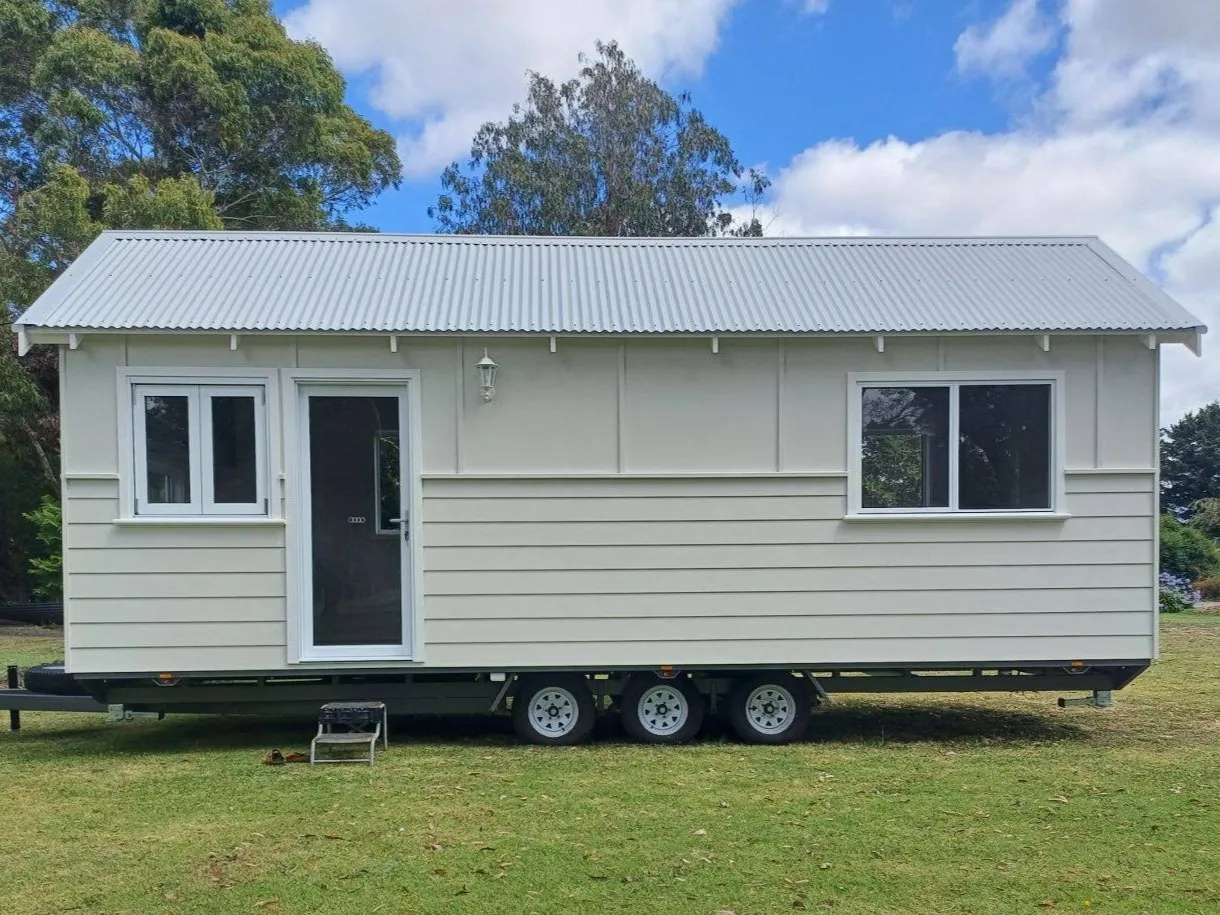
This is the most common type I sell. A THOW is built on a registered trailer and can be towed to a new location. For self-towing — where a standard tow vehicle pulls the home — road-legal dimensions in Australia are a maximum of 2.5m wide, 4.3m high, and a trailer length of 12.5m, with a gross weight under 4,500kg.
The big advantage is flexibility. You can move it. You can park it on private property in many council areas without full development approval. And if your circumstances change — new job, new relationship, new state — the home comes with you.
The trade-off is size. Keeping everything under 4,500kg means most practical THOWs are 6m to 8.5m long. Once you push past 8m with two lofts and full fit-out, you're dancing very close to that weight limit.
Wider Towable and Transportable Tiny Homes
Not every tiny home fits the 2.5m self-tow width. There's a growing category of wider builds — 3m, 3.4m, and 4m wide — and they're changing what's possible in a small footprint.
A 3m wide tiny home can still be towable, depending on the size, weight, and the delivery driver's permits. These homes typically have their own VIN and are towed by a qualified driver rather than the owner.
At 3.4m and 4m wide, the home is delivered on a truck. Some builders are now building at this width on trailer, and the extra space is noticeable — a 4m wide tiny home feels much closer to a conventional home inside.
More broadly, truck delivery is becoming common for tiny homes of all sizes, especially over long distances. It's gentler on the home — less road vibration, less wear on the build, and fewer things shifting in transit.
Tiny Homes on Skids
Same idea as a THOW, but without the trailer underneath. A skid-mounted tiny home sits on steel bearers and gets craned onto a site. It's still relocatable, but you'll need a truck and crane rather than just a tow vehicle.
Skid homes are easier to insure (insurers are more comfortable when there are no wheels involved) and can sometimes be slightly larger since you're not carrying the weight of a trailer chassis. But you lose the grab-and-go flexibility.
Modular and Prefab Tiny Homes
These are factory-built homes that arrive on a truck in one or more modules. They're typically larger than a THOW — think 30 to 60 square metres — and sit on stumps, piers, or a slab.
Because they're fixed to the land, they usually require building approval under the National Construction Code. That means more paperwork, but it also means you can potentially access traditional home loan products. Some major banks now offer financing for certain prefab homes on foundations, which is a significant shift.
Flat-Pack and DIY Kits
If you've got the skills, time, and a very solid understanding of weight compliance, a flat-pack kit can bring the cost of the kit itself down to the $25,000–$60,000 range. Keep in mind this is the kit price only — by the time you add fitout, electrical, plumbing, and compliance certification, the total cost is significantly higher.
But I'll be direct — DIY builds are where I see the most compliance issues come up. Weight blowouts, non-compliant electrical work, and trailers that weren't properly engineered.
If you go this route, budget for independent engineering certification and electrical sign-off at a minimum.
New Build vs Pre-Owned: Which Is Right for You?
This is the first real decision most buyers face, and the answer depends on your timeline, budget, and how specific your needs are.
Buying New (Custom Build)
A custom build gives you control over layout, materials, fixtures, and off-grid setup. Most Australian builders work on a 12 to 16 week timeline for standard builds, longer for highly customised or larger homes.
Expect to pay $100,000 to $170,000 for a turn-key THOW from a reputable builder. That usually includes the trailer, full fit-out, appliances, and delivery within a reasonable distance from the factory. Prices have increased significantly since 2021, when quality builds started at $80,000 to $100,000. That reflects evolved designs — engineered steel frames, full off-grid solar, smart home systems, and more comprehensive compliance documentation.
What it doesn't usually include — and what people forget to budget for — is the deck, stairs, site preparation, off-grid upgrades, and council approval costs. Add $5,000 to $25,000 depending on your setup.
The downside is time. If you need a home in the next four weeks, a custom build isn't it.
Buying Pre-Owned
A pre-owned tiny home gets you in faster and often at a lower price point. Through the THA marketplace, we regularly sell pre-owned tiny homes ranging from $80,000 to $160,000, with some moving in under a week.
The reality with pre-owned is that you're inheriting someone else's choices — their layout preferences, their spec level, and their approach to weight management.
What's encouraging is what the early resale data is showing. The common assumption is that tiny homes depreciate like caravans, which can lose 30–50% of their value in the first five years depending on brand and condition. Across the homes we've sold through our marketplace, the data tells a different story — pre-owned tiny homes are moving at 70–85% of original build cost, especially homes built before recent construction cost increases. It's too early to call them appreciating assets, but they're behaving more like property than caravans.
The fact that a secondary market exists at all is a sign this sector is maturing. A few years ago, if you wanted a tiny home, you built one. Now there are quality pre-owned options with proven performance history, existing compliance documentation, and often upgrades the original buyer invested in.
This is where working with someone who assesses tiny homes for a living makes a measurable difference. I inspect every home — in person or virtually — review all available documentation (compliance certificates, builder specs, weight records), assess the overall condition, and work with the seller to get the home fully ready for delivery. The number of pre-owned homes I've assessed where the weight was higher than the owner realised, documentation wasn't as complete as expected, or the home required customised planning and updated delivery coordination would surprise you.
If you're considering a pre-owned home, here's my minimum checklist:
Trailer engineering certification and registration documents
Proof of Aggregate Trailer Mass (ATM) rating vs actual weight
Electrical Certificate of Compliance
Plumbing compliance certificate (if applicable)
Gas compliance certificate (if fitted)
Build documentation or spec sheet from the original builder
Evidence of any modifications made after the original build
If the seller can't provide these, that's a red flag worth paying attention to.
One more thing worth knowing: tiny homes fall into an unusual category when it comes to marketplaces. They're not classified as real property, but they're six-figure assets that require transport logistics, compliance documentation, and buyer education. Traditional property platforms don't really accommodate them, and in many cases there isn't a clear place to sell or find a tiny home publicly. Most have historically changed hands privately through Facebook groups and word of mouth, which is exactly why I built the THA marketplace.
Trailer Health and Weight Compliance
I bring this up early because it's the single biggest technical issue I see — and the one most buyers don't think about until it's too late.
Every tiny house on wheels sits on a trailer with a rated Aggregate Trailer Mass (ATM). That rating is the absolute maximum the trailer can legally carry, including its own weight and everything built on top of it.
For standard 2.5m wide THOWs, the critical threshold is 4,500kg. Below that, you're in the light vehicle category — standard electric brakes, towable with a heavy-duty ute or 4WD with appropriate towing capacity. Above 4,500kg, you jump into the medium/heavy vehicle category, which requires air-over-hydraulic brakes. A trailer rated above 4,500kg alone costs $30,000–$40,000. That's just the trailer. Wider homes (3m+) sit in a different weight and transport category altogether — the delivery logistics section below covers that in more detail.
Most buyers want to stay under 4,500kg. And most reputable builders can deliver a fully kitted-out 7.2m home under that limit without too much trouble. But push to 8.5m or longer with two lofts, stone benchtops, and a full-size bathroom, and you're in territory where every material choice matters.
For pre-owned homes, ask for the most recent weight documentation available. People add things over time — shelving, storage, upgraded appliances. It all adds up, and a home that was 200kg under its ATM three years ago might be right on the limit now.
Trailer Condition
Weight is only half the picture. The trailer itself needs to be in good shape — it's the foundation of the home.
For pre-owned homes, the things to check are chassis corrosion, the condition of axles and bearings, brake function, and suspension wear. A home that's been parked in one spot for a few years without trailer servicing may need attention before it's road-ready again. If you're buying privately, it's worth getting a private building inspector or an independent mechanic with trailer experience to assess the chassis and running gear before you commit.
For new builds, it's worth confirming that the trailer has been engineered specifically for the home being built on it, and that it's rated appropriately for the total build weight — not just the structure, but everything inside it.
Where needed, a trailer assessment is part of the work I do for buyer clients — and it's something I'd recommend for anyone buying privately as well.
Setting Up Off the Wheels
This is something a lot of new owners don't think about, and it matters for both safety and the long-term health of the trailer.
When a THOW arrives at its site, the temptation is to park it and start living. But leaving a tiny home sitting on its wheels and tyres long-term is one of the worst things you can do. Tyres develop flat spots and degrade. Suspension compresses unevenly. Bearings corrode without movement. And the entire weight of the home is being carried by components that were designed for transport, not permanent load-bearing.
The right approach is to get the home up off its wheels onto concreted steel supports. This transfers the weight from the trailer's running gear to proper load points, takes the pressure off tyres and suspension, and keeps the home level and stable. A specialised tradesperson can set this up, and some delivery drivers offer this as part of their service.
It also means when you do need to move the home — whether for maintenance, relocation, or resale — the trailer is still in good condition rather than having sat under load for years. I've seen homes where the tyres were flat, bearings were seized, and brakes had corroded because the home was parked on its wheels for two or three years without any trailer maintenance. That's a $3,000–$5,000 problem that's completely avoidable.
Tiny Home Regulations in Australia: State by State
Important: THA is not affiliated with any council or government body. The information below is general guidance only and may not reflect the most current rules in your area. Always contact your local council directly to confirm what applies to your specific property and situation before making any decisions.
The short version: there is no single national framework for tiny homes. Regulations vary by state, and within each state, individual councils can interpret and apply planning rules differently. The Australian Tiny House Association maintains a state-by-state breakdown, and Fred's Tiny Houses has built a free council-by-council database worth checking.
Victoria
Victoria is currently one of the most progressive states for tiny home living. The state has introduced a pathway allowing secondary dwellings under 60 square metres without a formal planning permit on lots of 300 square metres or larger, provided there are no flooding, environmental, or other special planning overlays. You still need a building permit and must meet siting and setback rules, but the planning hurdle is largely removed.
On top of that, Surf Coast Shire has run a tiny houses on wheels pilot program. Mount Alexander Shire has allowed residents to live in a THOW on a property with an existing dwelling, provided it doesn't become a permanent structure.
Western Australia
WA made national headlines when new regulations allowed residents to live in tiny homes on private property for up to two years with council approval. The Shire of Esperance went further — becoming the first Australian council to recognise tiny houses as permanent dwellings with only planning approval required (no building permit).
New South Wales
NSW is moving, but slowly. Shellharbour Council has backed a pilot program allowing tiny homes on residential blocks as long-term rentals without development consent. Other councils are exploring tiny homes for temporary and crisis accommodation.
Queensland
In Queensland, a THOW is classified as a caravan under transport legislation. On your own property on the Gold Coast (where I'm based), you may be able to live in a THOW permanently, but you'll need either building approval or a camping area licence plus plumbing approval. Each council handles this differently, and I've seen wildly different interpretations from councils within the same region.
South Australia
SA treats tiny homes as ancillary accommodation under the Planning, Development, and Infrastructure Act 2016. You'll need both planning and building approval. The home must be subordinate to the main dwelling and share utility connections. On the positive side, SA allows tiny homes to be self-contained.
Tasmania and Northern Territory
Both are still in early stages. Some Tasmanian councils are open to tiny homes on rural properties, but there's no statewide framework yet. The NT has very limited specific regulation around tiny homes.
The Practical Advice
Before you buy a tiny home or commit to a build, call your local council and ask these three questions:
Can I place a relocatable dwelling (or caravan) on my property for permanent residential use?
What approvals do I need — planning, building, or both?
Are there any overlays on my property (flood, bushfire, heritage) that would affect approval?
Get the answers in writing. Council officers are helpful, but verbal advice doesn't hold up if there's a dispute later.
Where to Put Your Tiny Home
Finding the right spot is half the battle. Here are the realistic options in Australia right now.
Your Own Land
The first thing to know: in most council areas, a THOW is treated as a secondary dwelling, which means there usually needs to be a primary dwelling on the property already. If you're buying vacant land and a tiny home is going to be the only structure on the block, a modular or prefab home on foundations is often the better fit — because it can go through the building approval process as a primary dwelling in its own right.
If there's already a dwelling on the property, buying a block gives you the most control. Rural lifestyle blocks with flexible zoning are ideal — particularly in areas where councils are actively pro-tiny-home (parts of regional Victoria, the Esperance region in WA, and some Gold Coast hinterland areas). Land costs vary wildly, but $80,000–$200,000 will get you a block in many regional areas.
Someone Else's Backyard
Parking a THOW on a friend's or family member's property is one of the most common arrangements I see. In many council areas, you can do this without development approval if the property already has an existing dwelling and you meet setback requirements. Get a simple written agreement covering rent, utilities, and notice periods.
Caravan Parks
Some caravan parks offer long-term sites for tiny homes. The advantage is ready-made infrastructure — water, power, waste connections, and sometimes even community facilities. The disadvantage is that not all parks accept privately owned tiny homes, and long-term residency rules vary.
Tiny Home Communities
Purpose-built tiny home villages and intentional communities are starting to emerge in Australia. They're still rare, but where they exist they offer shared infrastructure, community, and often more flexible planning arrangements than standard residential zones.
Private Land Rental
Platforms like Hipcamp connect tiny home owners with landowners willing to rent space. This can work well for short-to-medium-term arrangements while you figure out your longer-term plan.
How Much Does It Actually Cost?
I'm going to give you real numbers rather than ranges you could find anywhere. These are based on what I see in the market every week.
The Home Itself
TypeTypical Price RangeDIY / flat-pack kit (kit only, before fitout)$25,000 – $60,000Turn-key THOW (6–7.2m)$100,000 – $130,000Mid-range turn-key THOW (7.2–10m)$130,000 – $155,000High-spec custom THOW (before upgrades like solar)$155,000 – $180,000+Pre-owned THOW$80,000 – $160,000Modular/prefab (on foundations)$120,000 – $250,000+
The Costs People Forget
Transport and delivery: Around $2,000 for local delivery, $5,000–$10,000 for standard interstate. For oversize homes or very long distances, costs climb well beyond this — cross-country road transport for wider homes has been quoted above $25,000. Sea freight is emerging as a viable alternative for interstate moves and can be substantially cheaper than road over long distances.
Site preparation: From around $4,500 upwards, depending on the site and type of tiny home. A THOW on someone else's property might just need levelling and concreted steel supports to get the home off its wheels. A fixed dwelling on your own land could need levelling, stumps, connections to mains services, and access clearing — easily $10,000+. Some suppliers offer site prep and council approval as part of their service, but most builders focus on the build itself. Most buyers prefer to manage site prep independently anyway, where they can usually find more competitive pricing.
Off-grid setup: A solar and battery package alone costs around $20,000. Add water tanks, filtration, and a generator backup, and a full off-grid setup runs $25,000–$40,000+.
Deck and stairs: $5,000 (used)–$30,000+ for a deck on a trailer for easy future transport.
Council approvals: You may need a development application (DA), a building approval (BA), or both — depending on your council and the type of tiny home. Council fees for both combined typically range from $400–$2,000+. This is just the council fees — if you engage a town planner or building certifier to manage the process, professional fees sit on top.
Insurance: See the insurance section below — it takes a bit of legwork, but cover is available.
Total Realistic Budget
For a brand new turn-key THOW delivered to a prepared site with basic external setup and insurance, most of my buyers land between $160000 to $220,000 all-in. That's the number I'd plan around. This does not include the cost of land if you're purchasing a block.
Financing Your Tiny Home
This is where the tiny home market is still catching up. Traditional home loans generally don't apply to THOWs because they're classified as caravans or vehicles rather than permanent dwellings.
Here are the options that actually work in Australia right now.
Personal Loans
The most common path for THOWs. Unsecured personal loans typically offer 1–7 year terms. Interest rates are higher than a mortgage, but approval is faster and you don't need property as collateral. Most of my buyers who go this route borrow between $50,000 and $100,000.
Caravan and RV Loans
If your tiny home is on wheels, some lenders classify it as a recreational vehicle and offer secured loans against the home itself. Terms and rates sit between personal loans and traditional mortgages.
Green Loans
A growing category. Some lenders offer preferential rates for eco-friendly housing, including tiny homes with solar, rainwater, and sustainable materials.
Prefab Home Loans from Major Banks
Some major banks, including Commonwealth Bank, now finance certain prefab and modular homes that are fixed to foundations and meet their lending criteria. If your tiny home is on foundations rather than wheels, it's worth exploring whether you qualify for a more traditional lending product with lower rates and longer terms. Eligibility criteria vary between lenders and change frequently, so speak directly to the lender or a mortgage broker familiar with non-standard housing.
Specialist Providers
There are specialist lenders and brokers who focus on non-standard housing and understand the nuances of tiny home lending. If mainstream lenders don't fit your situation, I can point you in the right direction — it's something I help buyers with regularly.
My advice: get your finance sorted before you commit to a build or make an offer on a pre-owned home. Knowing your budget changes how you approach every other decision.
Insuring Your Tiny Home
Insurance is one area where the tiny home market is still maturing. It requires a bit more legwork than insuring a traditional home, but cover is out there if you know where to look.
The Reality
Insurance for tiny homes in Australia is still catching up with the rest of the market. Benjamin & Benjamin, which was the primary insurer through a partnership with the Australian Tiny House Association, stopped offering new policies in November 2023, and the number of providers willing to cover tiny homes is still limited. It can take a few conversations with different insurers before you find the right fit — but cover is available, and it's getting easier as insurers become more familiar with the product.
What's Currently Available
CIL Insurance (Brisbane-based, part of the Suncorp Group) remains one of the more accessible options for tiny homes on wheels. They have experience with this type of cover and understand what a tiny home is, which helps. However, they do have specific requirements — the home typically needs to be on private property with wheels and drawbar still attached, and not hard-wired into permanent services.
NRMA may offer cover through their caravan insurance products, but this typically requires a phone application rather than an online quote, and outcomes vary depending on the specifics of your home and situation.
Manufactured Homes Insurance Agency (MHIA) is worth investigating if your tiny home is on skids or fixed to bearers rather than on wheels.
QBE, Youi, and Allianz have been reported as insuring tiny homes in some cases, but experiences vary widely. Some owners have had success; others have been declined by the same insurer.
The Australian Tiny House Association has flagged insurance as a high priority and is working to secure better options, but progress has been slow.
How to Improve Your Chances
The single biggest thing you can do is have comprehensive compliance documentation. Homes with full electrical certificates, engineering certification, plumbing compliance, gas compliance, and original builder documentation are significantly easier to insure than homes without.
Other factors that help: owning the land your tiny home sits on (rather than renting a site), having the home classified as a caravan with proper registration, keeping the build value clearly documented, and working with an insurance broker who has experience with non-standard dwellings.
What It Costs
Premiums vary depending on the home's value, location, and whether it's stationary or being moved — and like the rest of the insurance market, costs have been rising. Get a quote early in your buying process so you can factor it into your budget.
My Advice
Explore your insurance options early — contact CIL, NRMA, and an insurance broker before you commit to a purchase so you know where you stand. And keep every piece of compliance documentation the builder gives you — it's your best asset when approaching insurers.
But here's what I actually tell my clients: regardless of whether you have a policy, start your own insurance fund. Put $100 a week into a separate account you don't touch. I've heard too many stories of claims not being honoured, policies being cancelled, or cover not extending to the specific situation when it mattered most. Your own fund means you know for sure that if and when you need the money, it's there. After a couple of years, you've built a solid buffer — and if you never need it, even better.
Going Off-Grid
About 40% of the buyers I work with want some level of off-grid capability — even if they're connecting to mains power as a backup. The most common setup I see is solar and battery with mains backup, which covers the majority of daily use and keeps the power bill close to zero.
Solar and Battery
A functional off-grid power system for a tiny home typically produces 8–10 kWh per day. That's enough for lighting, a fridge, charging devices, a washing machine, and moderate heating/cooling use. Expect to spend around $20,000 on a solar and battery package including panels, batteries, inverter, and installation.
Water
Rainwater collection with a filtration system is the standard approach. Tank size depends on your roof catchment area and local rainfall — 5,000 to 10,000 litres covers most tiny home needs. Budget roughly $3,000–$6,000 for tanks, guttering, pump, and filtration — costs vary depending on tank size, site access, and whether you're DIYing or getting it installed.
Waste
Composting toilets are the practical choice for off-grid tiny homes. No black water tank, no pump-out schedule, no connection to sewer infrastructure. A quality composting toilet costs $1,500–$4,000 and can save around 35,000 litres of water per year. Grey water from sinks and the shower can be managed with a grey water system — expect a couple of thousand depending on complexity and setup.
Total Off-Grid Setup
For a fully self-sufficient system covering power, water, and waste: $30,000–$40,000+. The biggest single cost is the solar and battery package.
Transport and Delivery
If you're buying a new build or a pre-owned home from interstate, transport logistics matter more than most people expect.
What It Costs
Local delivery (within 100km of the builder): around $2,000. Standard interstate (e.g., Queensland to Victoria): $5,000–$10,000. For oversize homes or very long distances, costs climb well beyond this — cross-country road transport for wider homes can exceed $25,000 depending on the home's dimensions and the route.
Sea freight is emerging as a practical alternative for long-distance interstate moves. Where road transport is prohibitively expensive or the home's dimensions make it impractical, coastal shipping can cut transport costs substantially. It's a newer option in the tiny home space, but it's becoming more common as buyers increasingly purchase interstate.
What Affects the Price
Distance is the obvious one. But site access is the hidden cost driver. A narrow driveway, steep grade, low-hanging trees, or tight corners can mean crane hire ($70–$100/hour), winch equipment, or even temporary road modifications.
For wider homes (3m+), transport requirements step up. A 3m wide home can still be towed with the right driver permits. At 3.4m and 4m wide, you're looking at truck delivery with wide-load permits and possibly pilot vehicles ($150–$400 per day per vehicle). Many builders and buyers are also opting for truck delivery on standard-width homes over long distances — it's easier on the home and often more practical than a long-distance tow.
Before Delivery Day
Confirm your site access is clear. Measure the driveway width, turning radius, and overhead clearance. Check with your council about any road access restrictions. And make sure your site prep is complete — level ground, concreted steel supports or bearers in place (so the home can be set up off its wheels), and utility connections ready if applicable.
I always recommend buyers do a site visit with the transport company before delivery. A quick 30-minute assessment can prevent a very expensive problem on the day.
Working With a Buyer's Agent
Helping both sides of a tiny home transaction go smoothly is the part of my work I enjoy most. But I'm including this section because most people don't even know buyer's agents exist in the tiny home space, and the ones who find out after they've had a bad experience wish they'd known sooner.
A tiny home buyer's agent makes sure everyone involved — whether that's buyer and seller or buyer and builder — is happy, informed, and protected throughout the process. In my case, that means:
Inspecting the home (in person or virtually) and assessing condition and documentation
Co-designing custom builds with you — layout, materials, finishes — and managing the full build on your behalf
Providing design direction and progress updates throughout custom builds so you're informed without carrying the stress
Working with the seller to get the home fully prepared for delivery
Negotiating price and terms on your behalf
Managing the entire transaction from listing through to settlement
Coordinating transport, delivery, and handover
Arranging trailer inspections where necessary
The tiny home market is still maturing, and it doesn't yet have the same consumer protections as traditional real estate. There's no standard contract, no mandatory cooling-off period on most private sales, and no formal requirement for sellers to disclose defects. Having a licensed professional in your corner changes the risk profile significantly.
Custom builds: This is the flagship service. I co-design your home with you — layout, materials, finishes, functionality — then match you with a vetted builder from my network based on your brief, budget, and timeline. From there, I manage the full build on your behalf: builder liaison, progress updates, quality oversight, contract negotiation, and delivery coordination through to handover. The volume of projects I coordinate simultaneously means my clients get access to priority scheduling, proven supply chains, and in some cases preferred pricing that isn't available going direct. Your $1,500 retainer is credited back at purchase — the builder pays my commission, so the representation is effectively cost-neutral.
Marketplace purchases: Every listing on the THA marketplace goes through a quality gate before it goes live — I personally inspect every home (in person or via FaceTime for interstate listings), review all available compliance documentation, verify specs with the seller, and assess overall condition. Retained buyers get priority access to new listings and off-market opportunities before they go public. I handle all enquiries, coordinate inspections (including virtual walkthroughs for interstate and overseas buyers), manage negotiations, prepare contracts, and oversee the full transaction through to settlement and delivery. That includes working with the seller on transport preparation — disconnecting services, emptying tanks, dismantling decks where needed — so the home arrives ready.
Both pathways include the same level of professional oversight, licensed representation, and dedicated support. Whether you're building custom or buying pre-owned, you get a licensed agent accountable to you from first call through to keys in hand.
Your Buying Timeline: What to Expect
These are realistic timelines based on how quickly things move when I'm managing the process for THA clients.
New Custom Build (with THA)
Research and planning — 2–4 weeks
Builder selection, design finalisation, and contract — 2–4 weeks (often faster — I've had builds confirmed within 24 hours of our first call)
Build — 12–16 weeks for most builds, longer for highly customised or larger homes
Delivery and setup — 1–2 weeks
Total: 3–5 months from decision to moving in.
These timelines are possible because I coordinate multiple builds simultaneously, know which builders suit which briefs, and can fast-track design decisions through established relationships. My clients get access to priority scheduling, proven supply chains, and in some cases, preferred pricing that isn't available going direct.
Without professional help, the research phase tends to take a lot longer. There are so many builders, so many options, and so many unknowns that it's easy to stall. I've had clients tell me they spent two years researching before reaching out.
Pre-Owned Purchase (with THA)
Search and shortlist — 1 week
Inspection, negotiation, and agreement — 2 weeks
Transport and delivery — 1–3 weeks
Total: 4–6 weeks from decision to moving in.
The pace is set by the buyer and seller — I've facilitated complete sales from first enquiry through to delivery coordination within a single week when both parties were ready to move. Having licensed representation already in place means nothing slows you down when the right home comes up.
Without professional help, the process tends to stretch out — browsing for months, second-guessing the condition, and sometimes missing out on homes that sell while you're still weighing it up.
The Questions I'd Ask Before Buying
Different questions matter depending on whether you're building new or buying pre-owned.
5 Questions for a Custom Build
What's included in the base price, and what's an upgrade? Builders quote differently. Make sure you're comparing apples with apples — some include solar, appliances, and delivery; others don't.
What compliance documentation will I receive at handover? You want an electrical compliance certificate, engineering certification, plumbing sign-off, and a VIN for the trailer at a minimum. This paperwork matters for insurance and resale.
How do you manage weight during the build? A good builder tracks weight throughout and can tell you how close the finished home will be to the trailer's ATM rating. This matters more than most people realise.
What's the realistic timeline, and what causes delays? Get a clear build schedule and ask what's held up previous builds. Material supply, weather, and order book size are the usual factors.
What warranty do you offer, and what does it actually cover? Warranty length varies hugely across the industry. Ask what's covered, what's excluded, and whether the warranty is transferable if you sell the home later.
5 Questions for a Pre-Owned Purchase
What is the trailer's ATM rating, and what does the home currently weigh? It's common for owners not to know the exact weight — if that's the case, aim for a truck delivery rather than a tow to be safe.
Does the trailer have a VIN? You need a VIN for towing. If there's no VIN, truck delivery is the way to go.
Can I see the electrical compliance certificate and builder documentation? Non-compliant wiring is a safety and insurance issue, and missing documentation makes the home harder to insure and resell.
Who built it, and are they still operating? You want to know you can go back to the builder if something comes up — and if they're not operating, that changes how you assess the home's long-term support.
Has the home been lived in full-time or used as a weekender? Full-time use means more wear — but also means systems have been properly tested. A weekender that's sat unused for long periods may have trailer and plumbing issues that aren't immediately obvious.
Next Steps
If you've read this far, you're serious about buying a tiny home. Here's what I'd suggest.
If you're still in the research phase — browse the THA marketplace to see what's currently available. It'll give you a feel for pricing, specs, and what different size homes actually look like inside.
If you know what you want but need help finding it — book a strategy call with me. We'll go through your requirements, budget, and timeline, and I'll tell you whether a new build or pre-owned home is the better path for your situation.
If you've found a home and want it assessed before you commit — that's exactly what the buyer's agency service is for. I'll inspect it (in person or remotely), review all documentation, and give you a clear recommendation.
Remote inspections and Australia-wide delivery available.
Bridget Rose is a licensed real estate agent, tiny home broker, and founder of Tiny House Agency — Australia's first licensed tiny home buyer's agency and marketplace, based on the Gold Coast, Queensland.